Delos is one of the most extraordinary places in the Greek world — a tiny, uninhabited island at the very centre of the Cyclades, a short boat crossing from the harbour of Mykonos, which in antiquity was held to be the most sacred spot in the Aegean. In myth it was the birthplace of the twin gods Apollo and Artemis, born to Leto on the island that Zeus had anchored to the seabed, and around that legend grew one of the greatest sanctuaries of the ancient Mediterranean. Pilgrims, priests and traders came here from across the Greek world, and for a time the island held the treasury of the Delian League, the alliance Athens led after the Persian Wars. Today the whole island is an open-air archaeological site and museum, protected as a UNESCO World Heritage Site, with no permanent inhabitants and no town — only ruins, sea and sky.
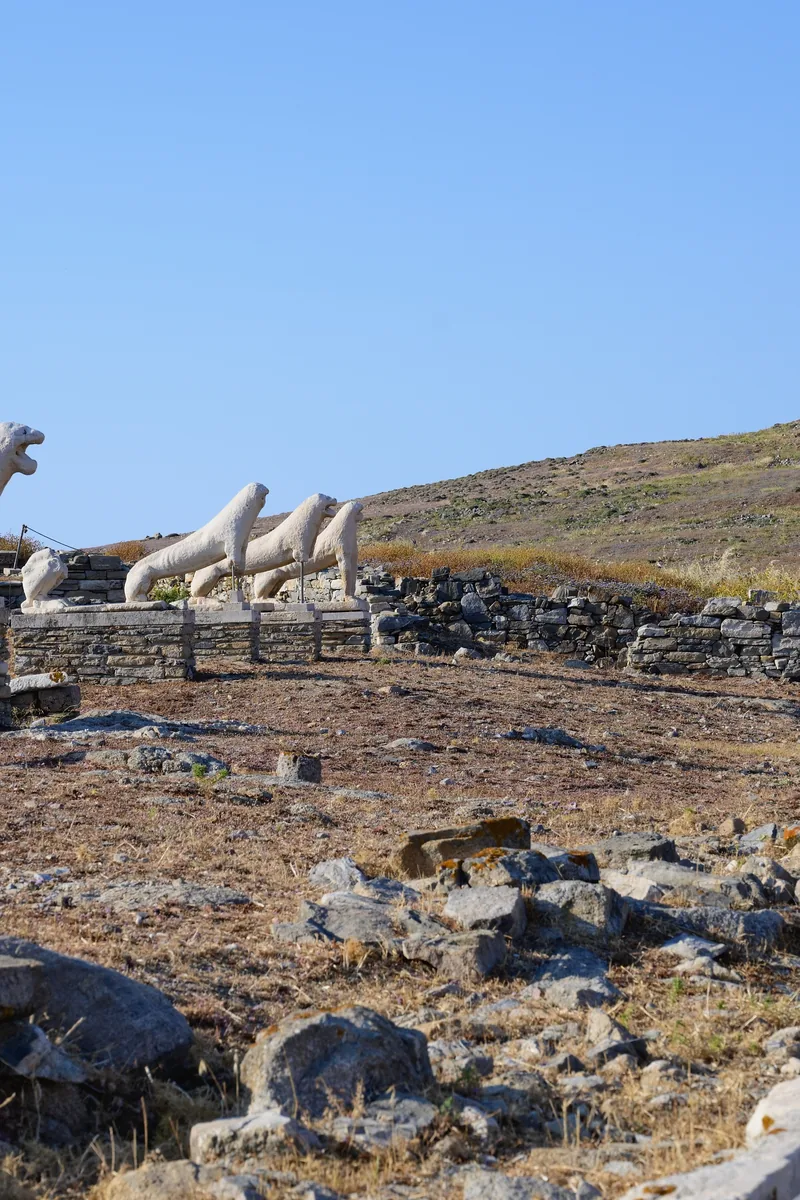
Delos was not only a religious centre but, in its Hellenistic and Roman heyday, one of the busiest trading ports and cosmopolitan cities of the eastern Mediterranean, home to merchants from Italy, Syria, Egypt and beyond. That double life — holy sanctuary and international marketplace — fills the ruins you walk through today. The Sanctuary of Apollo, with its temples, treasuries and altars, sits at the heart of the site; nearby stands the famous Terrace of the Lions, a row of archaic marble lions that once guarded the sacred lake. Beyond them spreads a residential quarter of wealthy merchant houses — the House of Cleopatra, the House of Dionysus, the House of the Masks — many still floored with brilliant mosaics, while the ancient theatre and the sacred slopes of Mount Kynthos rise above. The Archaeological Museum of Delos, on the island itself and included in your ticket, holds the original sculptures and finds gathered from more than a century of French excavation.
Because Delos has no town and is reached only by boat, a visit takes a little planning, and that is exactly where we help. Boats cross from Mykonos in around thirty to forty-five minutes, running mainly in the morning and returning in the early afternoon, so most people visit for a half-day. The island is exposed and almost entirely without shade, so an early crossing, a hat, sunscreen, water and sturdy shoes make all the difference. Because entry is timed by the hour, we handle the ticketing in your own language and reserve the slot you want, so once you step off the boat you can give your energy to the sanctuary and the sea light rather than the queue on the quay.